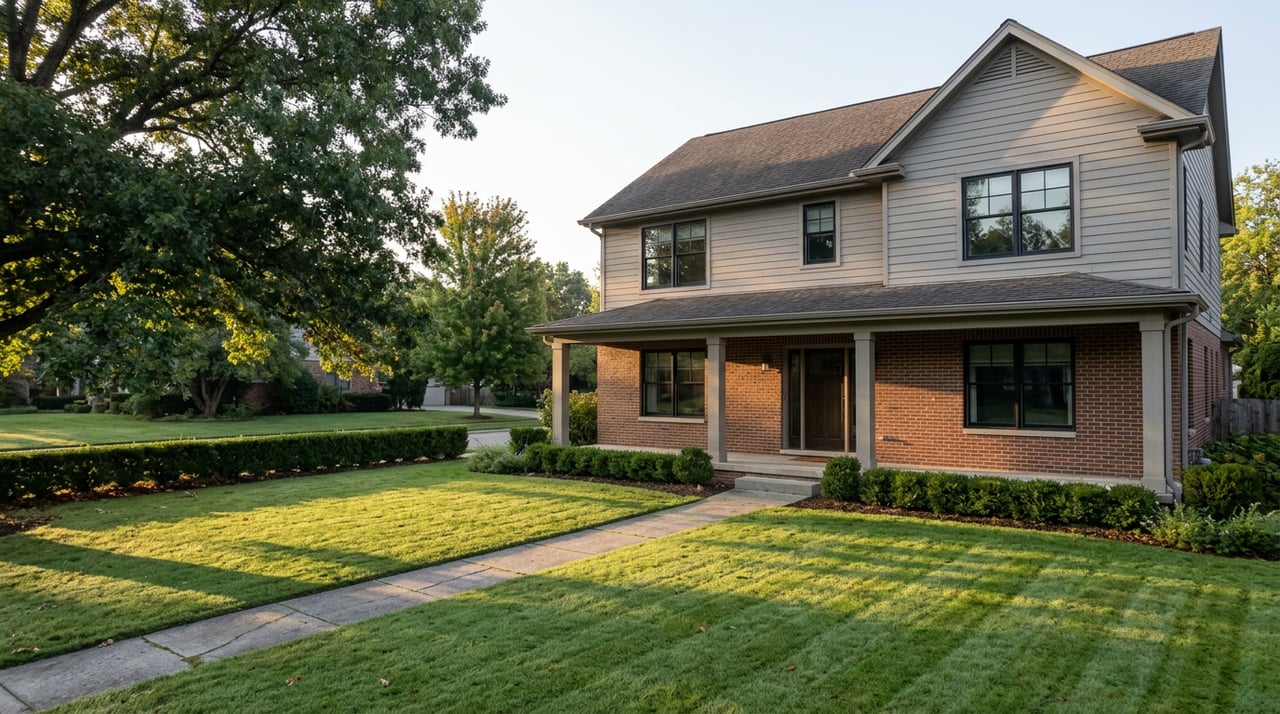
A buyer scrolling listings in Harvest eventually stops on the tax estimate line. It's lower than the same square footage in Madison or Huntsville, sometimes by a few hundred dollars a year, sometimes by close to a thousand. It reads like a straightforward discount, the kind of number that makes a house feel like the smarter buy before anyone has walked through the front door.
Then, somewhere before closing, a second question shows up that the tax line never answers: is this house on public sewer, or does it have a septic tank in the backyard? In Harvest, sewer service is a parcel-by-parcel fact. It's the other half of the arithmetic, and buyers should check it for each property.
The Number On The Tax Bill
Madison County's tax collector office publishes the rates, and the gap between Harvest and its neighbors is real. Property inside the city of Huntsville is assessed at $5.80 per $100 of assessed value. Inside Madison city limits, it's $6.95. Property outside any municipality, which describes most of Harvest, is assessed at $3.35 per $100 on the land and $3.65 per $100 on improvements, the lowest combination in the county.
| Location | Rate per $100 assessed value |
|---|---|
| City of Huntsville | $5.80 |
| City of Madison | $6.95 |
| Triana | $6.15 |
| New Hope, Gurley, Owens Cross Roads | $4.05 |
| Unincorporated Madison County (most of Harvest) | $3.35 land / $3.65 improvements |
Run those rates on an actual house and the gap stops being abstract. A $350,000 home carries an assessed value of $35,000, which is 10 percent of market value under Alabama's residential assessment rules, according to SmartAsset. At Huntsville's rate, that's about $2,030 a year. Inside Madison city limits, about $2,433. Apply the unincorporated improvements rate to that same $35,000 and the bill lands closer to $1,278, which puts a Harvest address roughly $750 below Huntsville and over $1,100 below Madison City on an identical home, every single year.
Over a decade, that's the difference between $7,500 and $11,000 in carrying costs a buyer never gets back. It's also exactly the kind of figure that gets circled and treated as the whole story, when it's really only the first half.
Why The Rate Is Lower
The rate is lower because the list of things the county is providing is shorter. Harvest is a census-designated place, not a city. There's no municipal government levying its own tax to fund a city police department, a city water utility, or a full-time paid fire department the way Madison and Huntsville do. Fire protection runs through the Harvest Volunteer Fire Department, a roughly 40-member volunteer department operating three stations, backed by neighboring Toney Fire and Monrovia Fire. That's a normal arrangement for unincorporated Alabama, and it's worth a short conversation with your insurance agent, since fire protection classification is one input carriers use when pricing a homeowners policy.
Water and sewer follow the same pattern. There's no Harvest city utility department, because there's no Harvest city government to run one.
The Question The Tax Bill Doesn't Answer
What Harvest has instead is the Harvest-Monrovia Water, Sewer and Fire Protection Authority, a standalone authority formed in 1965 to run the area's water system. Sewer came later. The board didn't add it until 2002, and even now the authority describes its coverage as extending to certain locations within the Harvest-Monrovia service area, not the whole footprint.
Because coverage is not universal, buyers should check service for each property. Some newer listings explicitly identify "public sewer" as a feature. Buyers can confirm whether a specific property has public sewer or a private septic system.
Lot Size and Septic Systems
Buyers moving out from Madison or south Huntsville often notice the lot sizes first. Harvest routinely offers half-acre to multi-acre parcels at price points where a comparable Madison lot would be a fraction of the size, and most buyers read that as simple abundance, more land for the same money.
Some of it is. But part of it is structural. Alabama's onsite sewage rules require a septic system's drain field to sit a minimum distance from wells, structures, and property lines, with the exact setbacks set by the Alabama Onsite Wastewater Board based on soil type and site classification. A septic-served home needs room the way a driveway needs pavement. On a lot serving a private system instead of a sewer main, that extra half acre isn't purely a lifestyle upgrade. It's frequently doing the job a city sewer line would otherwise do underground, which is one more reason those parcels were platted larger to begin with.
What To Verify Before You Write An Offer
None of this makes Harvest a harder place to buy. It makes it a place where due diligence looks a little different than it does five minutes away in Madison, and the smart move is getting these answers before you're under contract, not during the inspection period.
- Ask the listing agent, in writing, whether the specific address is on public sewer or septic, and which utility serves the water. Don't assume based on the subdivision name alone, since coverage can change street to street inside one development.
- If the home is on septic, budget for a dedicated septic inspection separate from your general home inspection. That inspection should confirm the system's age, its last pump date, and its remaining capacity for the household size you're planning around.
- Call your insurance agent early and ask how the property's fire protection class affects your homeowners premium, since volunteer department coverage is rated differently than a full-time municipal department in some carriers' formulas.
- If you're financing, ask your lender whether anything about the property's septic system needs to be addressed.
Quick Answers
Is every home in Harvest on well water? No. Most of the area's water runs through the Harvest-Monrovia Water, Sewer and Fire Protection Authority's public system. Private wells exist on some older and more rural parcels, but they're the exception rather than the rule.
What should I ask my lender about a septic system? Ask your lender whether anything about the property's septic system needs to be addressed as part of your financing.
How do I find out which system serves a specific Harvest address before I make an offer? Ask the listing agent to confirm it in writing, and if there's any ambiguity, contact the Harvest-Monrovia Water, Sewer and Fire Protection Authority directly. They can tell you what serves a given parcel faster than a subdivision brochure can.
The tax rate on a Harvest listing is a genuine reason the numbers can work in a buyer's favor. But a good offer accounts for what's underneath the yard, not just what's printed on the tax bill. If you're weighing a move to Harvest against Madison or Huntsville and want the full picture on a specific address, James Stallworth and the team at Stallworth Real Estate can walk the actual utility and septic history parcel by parcel before you write anything. Let's Connect: Start with a Free Home Valuation.
This article is general information, not legal, tax or financial advice. Consult a qualified professional about your situation.